
This page is a repository for the data I collect on rape and sexual assault. It’s here so I (and others) can link to it without having to repeat or continuously update data with each article.
I will keep adding to the page but for now, the data covers:
Australian Victimisation Rates
Reporting rates, actual rates and conviction rates
If you have any questions, notice any mistakes or would like to request additional data you can email me info at janegilmore dot com
Note on terminology:
The Australian Bureau of Statistics ABS does not use the word rape. They include all rape and sexual assault data in the term sexual assault. While I don’t like this terminology I use it to refer to ABS data for consistency and accuracy.
Also, the ABS categorises all data on crime to females and males. In 2021-22 they have started to collect more diverse data on gender and sexuality but this is not yet reflected in their published data. “Male” and “female” are the labels given in crime data by police, courts and in surveys by the person being interviewed.
Australian Victimisation Rates
Australian data shows that rapes and sexual assaults have been steadily increasing over the last fifteen years, concentrated on girls aged 10 to 17 and becoming much more significant since 2015.
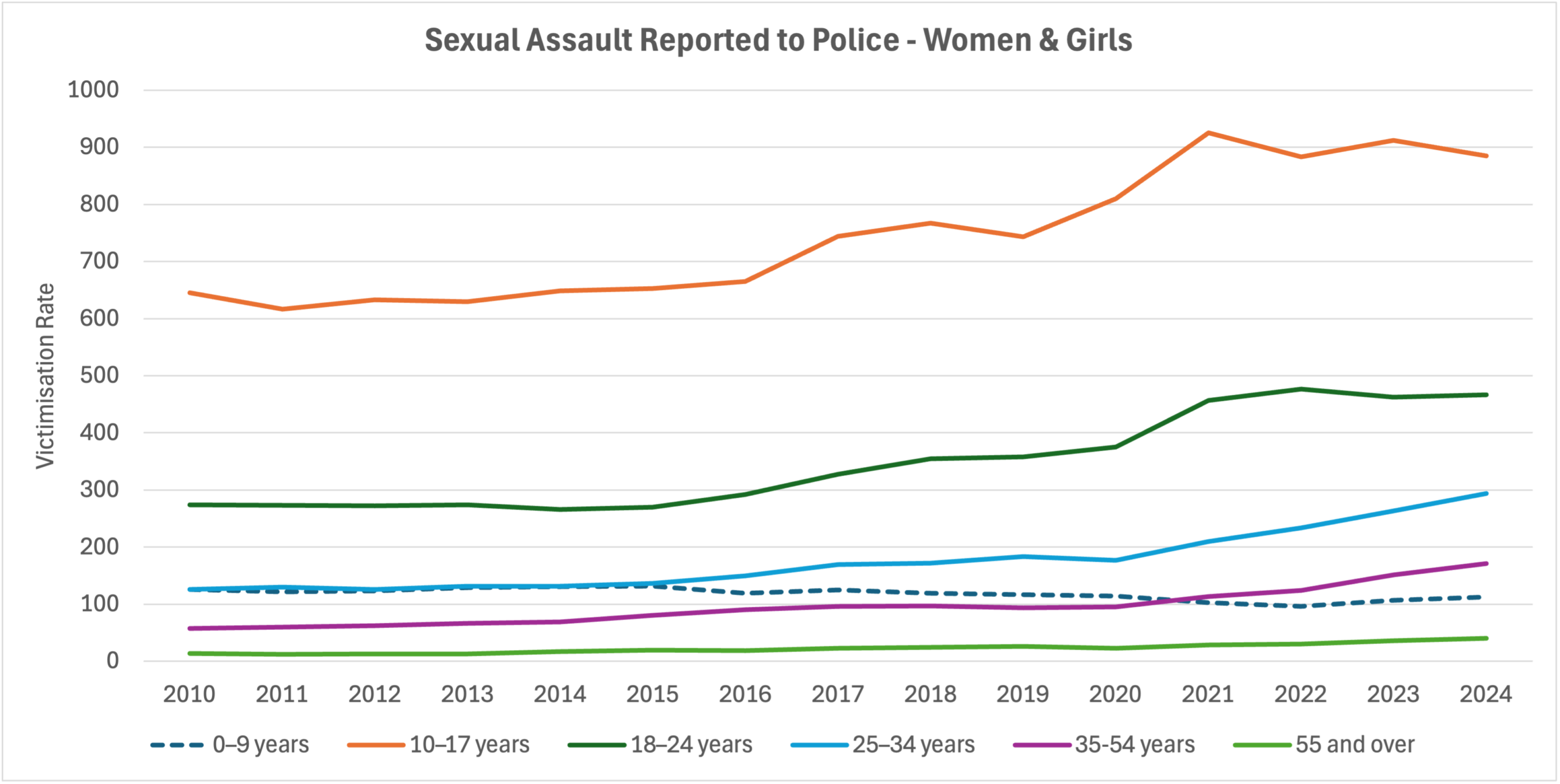
Some things to note in this graph:
Sexual assault data includes rape, attempted rape and sexual assault crimes reported to police across the whole of Australia. There are some variations in legal terminology and definitions between jurisdictions, but they’re similar enough that the crimes captured by this data are substantially the same. Sexual harassment and indecent assault crimes are not included in this data.
Trends: This is victimisation rates (the number per 100,000 people) which removes increases due to expanding populations. Some people assert that the increasing rates is due to increased reporting rather than a genuine increase in the actual rate of sexual violence. The most reliable data we have on reporting rates comes from the Australian Bureau of Statistics Personal Safety Survey, which says that the rate women report sexual violence to police has decreased significantly over the last ten years.
This means the increase in victimisation rates since 2015 are even more likely to significantly underestimate the actual rate of sexual violence happening to Australian women and girls.
The only line that trends downwards is girls aged 0-9 (the broken line on the graph).
Sexual Assault – rate of reporting to police
Women who have been sexually assaulted by a man since the age of 15, whether most recent sexual assault reported to police (2016 and 2021-22 record the % reported to police of most recent incident in the last ten years).
| 1996 Women’s Safety Survey (Table 4.5) | 11% |
| 2005 Personal Safety Survey (Table 7) | 16% |
| 2012 Personal Safety Survey (Table 17) | 19% |
| 2016 Personal Safety Survey (Table 10.3) | 13% |
| 2021-22 Personal Safety Survey (Table 5.1) | 8% |
It’s worth noting that the 2021-22 survey was done during covid and many participants might have been in lockdown while the survey was conducted. This might skew the results and it could explain the significant drop between 2016 and 2021-22. We won’t know until the next iteration of the survey comes out in mid 2027. However, given the trend over the preceding ten years, it’s likely that the reporting rate has continued to decline but that perhaps this may have been exaggerated during the covid years.
Data on children: people often assume that mandatory reporting will inflate police reports of sexual violence against children. It doesn’t. Mandatory reporting does not necessarily got to police and even if it does, it doesn’t necessarily show up in data like this. Police have to record something as an offence for it to appear on this graph and police are not usually the ones who get the mandated reports, it’s child protection authorities and they are so structurally under-resourced that they are incapable of protecting children.
That’s assuming people report correctly. Even people who are mandated to report child sexual abuse (teachers, healthcare workers, police, all adults in some jurisdictions) don’t always know where to take those reports or they’re scared of doing more harm if they do report. Sometimes they turn up at the front desk of a police station. Sometimes they report to child protection authorities. Sometimes they tell their boss who tells no one.
Despite these limitations. In 2020-21, 10% of reported sexual abuse cases were substantiated by child protection authorities. That’s 6,741 cases substantiated of over 67,000 cases reported. ABS data suggest about 12% of cases reported to police end in conviction, so roughly 800 convictions would be recorded and about half of those would be overturned on appeal. That’s around 400 men who faced actual consequences after over 67,000 reports of child sexual abuse and at least nine times that many cases that were never reported.
There are no consequences for sexually abusing children.
Data on older women: The ABS data groups by decades up to 65. I’ve shown the data for women over 35 in groups of 20 years because the graph was getting too messy to read with 8 lines and the trends and rates are roughly comparable across the twenty years for each group. However, there is a huge difference in the type and effect of rape committed against a 56 year old woman living a busy and independent life in the inner city and rape of a 90 year old woman living in aged care in a regional area. The 90 year old woman is less likely to report and far less likely to be taken seriously, particularly if she has any signs of dementia or are related memory issues. Myths say that older women don’t get raped and that people with dementia aren’t traumatised by rape. This is agist, misogynistic nonsense but it does erase the lives of older women from the data used for this graph.
Sexual Assault – age discrepancy between victims and offender
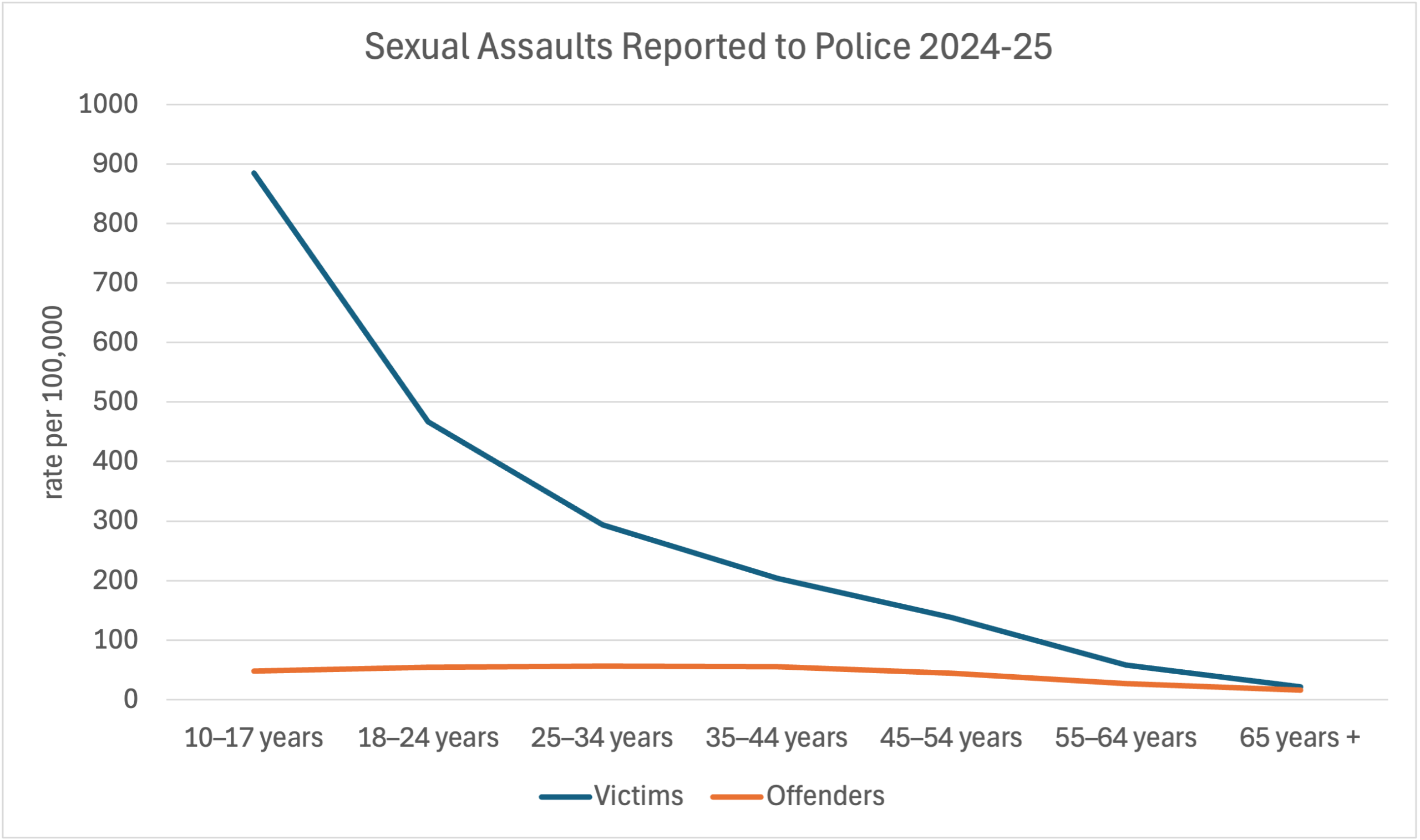
Police are proceeding against men of all ages, although teenage boys are under represented. The offender rate doesn’t start to drop off until men are in their mid-forties. So either all the boys and young men who are raping and sexually assaulting girls are erased from the crime data or it truly is that men of all ages are committing these crimes against teenage girls. And even then, the vast majority are not experiencing any consequences.
Of the crimes reported to police, a disproportionate number of victims were women. The Australian Childhood Maltreatment Study shows that the person most likely to sexually abuse a teenage girl is a teenage boy. Despite this, teenage boys are underrepresented in the offender data provided by police.
Australian Offender Rates
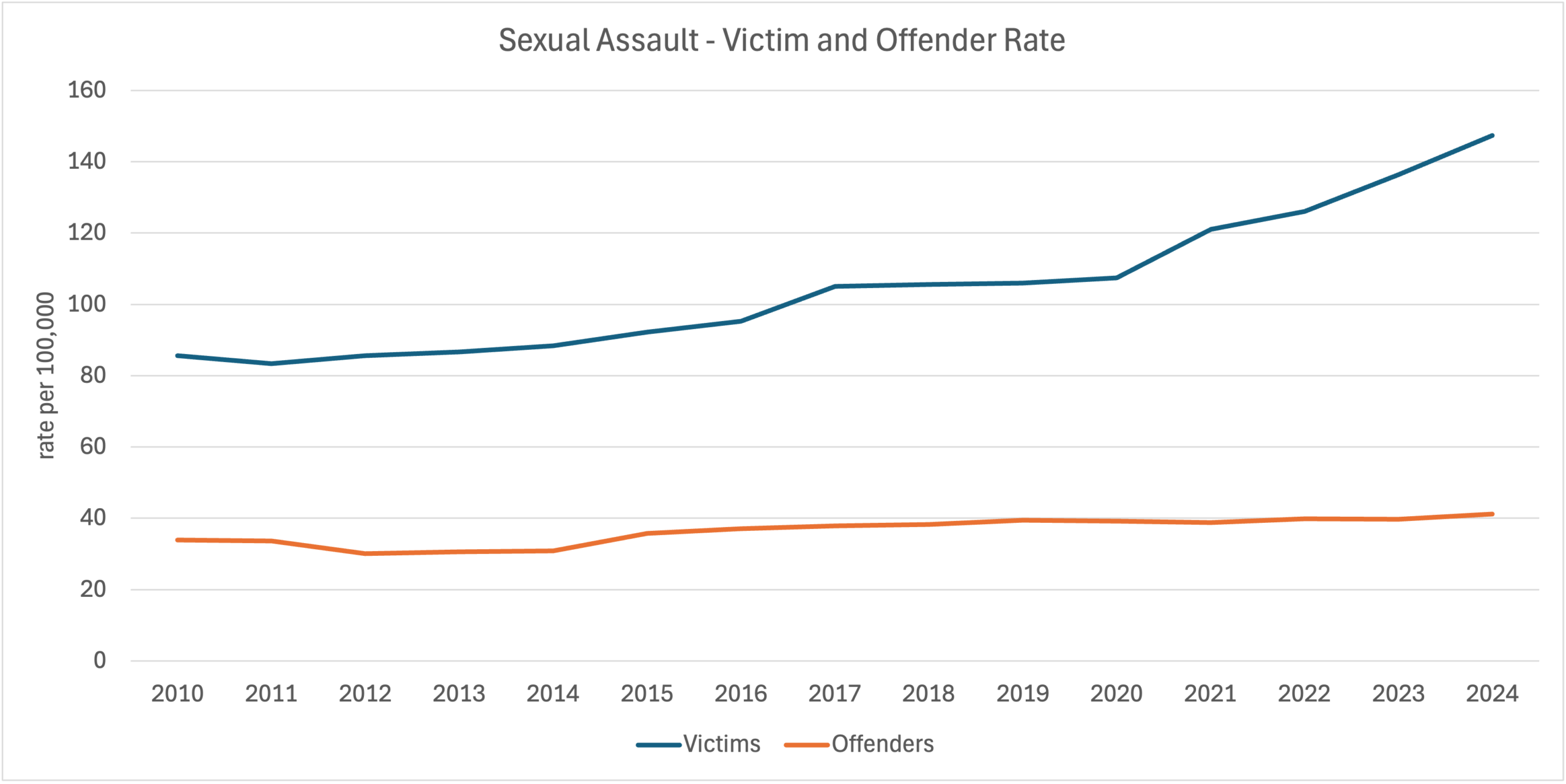
This is the rate of offenders proceeded against by police in comparison to victims reported to police. Again, this is the rate per 100,000 people so expanding population in Australia can’t account for the increase in victims.
Reporting rates, actual rates and conviction rates
When we take the actual number of reports to police and map it against the estimated reporting rate, we can see the scale of the problem.
Between 2014 and 2014 the estimated increase in total sexual assaults in Australia is around 360,000 per year.
Between 2014 and 2024 sexual assaults in Australia increased by roughly 350%.
Keep in mind, this is not one to one matching of data between crimes and courts. There are delays and mismatches in reporting that make such an exercise impossible. What this data does show is a pattern over time.
| 2014 | 2016 | 2018 | 2020 | 2022 | 2024 | |
| Sexual assaults reported to police (Source: ABS – Recorded Crimes, Victims) | 20,741 | 23,040 | 26,325 | 27,538 | 32,771 | 40,087 |
| Estimated percent of women who report sexual assault to police (Source: ABS – Personal Safety Survey)* | 15% | 13% | 10% | 8% | 8% | 8% |
| Estimated unreported sexual assaults (calculated from above data) | 101,265 | 148,900 | 170,130 | 304,245 | 362,060 | 442,889 |
| Estimated total sexual assaults (calculated from above data) | 122,006 | 171,940 | 196,455 | 331,783 | 394,831 | 482,976 |
| Guilty outcomes (Source: ABS – Criminal Courts, Australia)** | 3,988 | 4,422 | 4,655 | 4,356 | 5,162 | 5,517 |
| Conviction rate of reported sexual assaults (calculated from above data) | 19% | 19% | 18% | 16% | 16% | 14% |
| Conviction rate of total estimated sexual assaults (calculated from above data) | 3.3% | 2.6% | 2.4% | 1.3% | 1.3% | 1.1% |
* I’ve smoothed the reporting rates over the years between iterations of the Personal Safety Survey. I assumed the rate since 2021/22 has not changed, but this survey was done during covid, which might have skewed the data. There is no way of knowing until the next survey results are published in 2027.
** This data does not map directly against the Recorded Crime Victim data. Court outcome data is published by financial year and crime data by calendar year. Additionally, it typically takes more than a year for rape and sexual assault cases to get to trial so there could be court outcomes in 2024 that relate to reports from 2021. These calculations are grouped together to show a pattern over time, they are not designed to match specific case outcomes.
International Trends
This is a summary of the most reliable data I can find for Canada, USA, UK and the EU. I will add more countries and data when I’ve had time to find and evaluate it. I am limited to data published in English because translations are not always reliable enough for me to be sure they’re accurate.
All the data I’ve cited is produced by credible agencies from robust sources.
It’s easer for me to get into the details of Australian data because Australia has fewer jurisdictions and more homogeneous legal systems in each state and territory, which makes data collection by the ABS easier. Also, after years of digging around the Australian data I am very familiar with the details of what is it (and what it isn’t). I don’t have the same familiarity with international data. The trends appear to be similar – increasing rates of sexual violence, decreasing reporting and accountability – but I can’t say that these are exact like-for-like with the Australian data because I don’t know all the subtle differences in definition and collection. I can say that when all these jurisdictions produce data showing trends of such similarity, the causes cannot be local.
Canada
Conviction rate for sexual assault is declining.
False reports are rare.
Rape and sexual assaults are mostly committed by men against women and the rate at which women report to police is around 6%
Girls aged 12-19 have the highest victimisation rate.
Overall rate of rape and sexual assault is increasing and is now higher than it has been since 1996.
USA
Rate of reporting to police is decreasing
Rate of occurrences is increasing
Roughly 90% of victims are female and 99% of offenders are male
UK
Rate of sexual violence has increased over the last ten years
People under 25 are the most affected and women aged 20-24 shows the highest rates.
Reporting rates have increased and conviction rates decreased
EU
Rape and other sexual violence crimes reported to police are increasing.
Across the EU there are too many variations in legal systems, legal definitions, police practices and law reforms to get a useful aggregate. However, low reporting and conviction rates in comparison to other crimes is an issue in almost all member states and conviction rates in relations to police reports is getting worse.
